
How Strong Should a Rugby Player’s Calves Be? New Research Reveals the Numbers

Introduction
In high-impact field sports such as rugby union, the role of the triceps surae complex (gastrocnemius + soleus) in repeated accelerations, changes of direction, contact impacts and foot-plant forces is substantial. The capacity of the plantarflexor musculature to produce high isometric force is likely a marker of performance and may also influence injury risk, particularly around the calf-Achilles complex. The authors of this study sought to fill a gap in normative data by quantifying isometric plantarflexion strength in professional male rugby union players, and comparing strength by positional group (forwards vs backs) and age groups.
Methods
Participants
The sample comprised 355 professional male rugby union players from nine English Premiership clubs, of whom 201 were forwards and 154 were backs.
Testing protocol
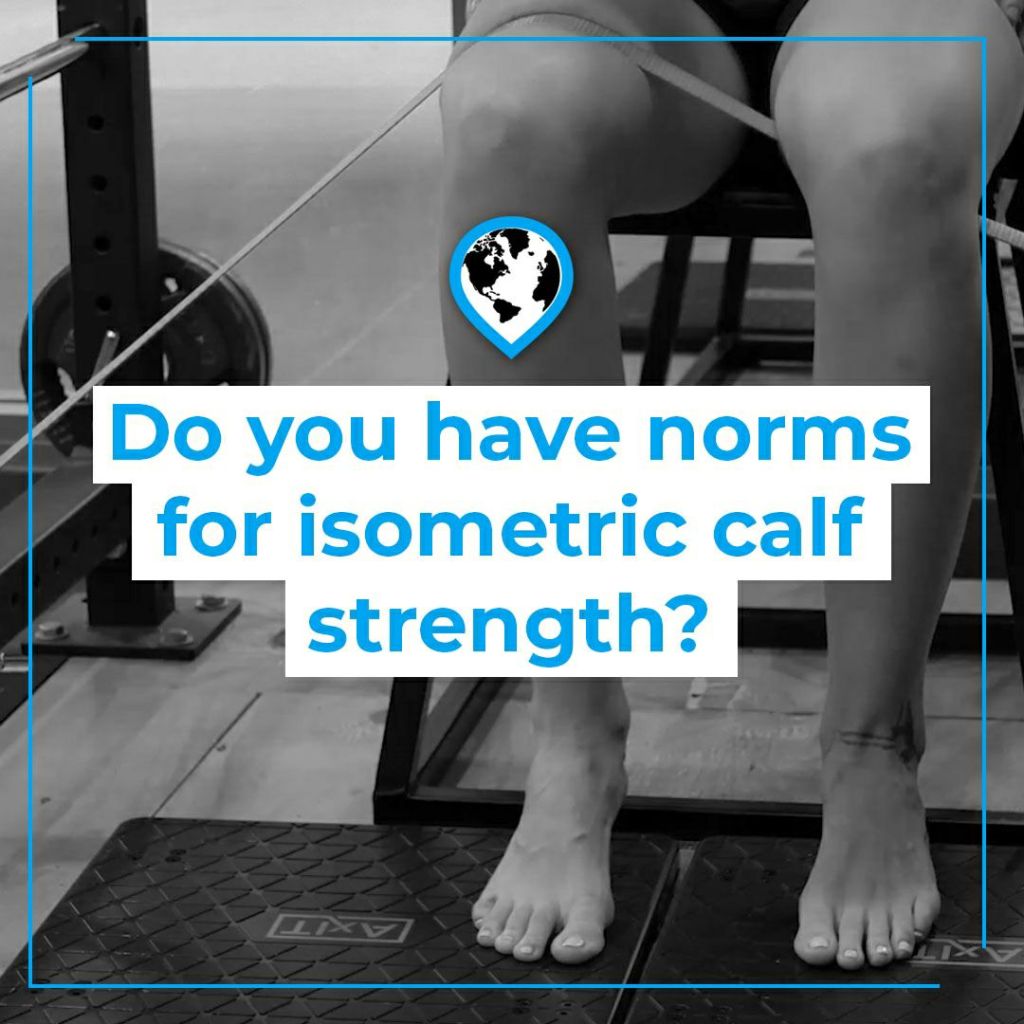
Maximal unilateral isometric plantarflexion strength was measured using a Fysiometer C-Station device in a seated position, knee flexed, and the ankle placed at maximal available dorsiflexion.
The strength values were normalised to body mass (× body-weight, xBW).
Combined limb strength (i.e., summing left + right) was also reported.
The authors also examined whether playing position or age category influenced plantarflexor strength.
Key Findings
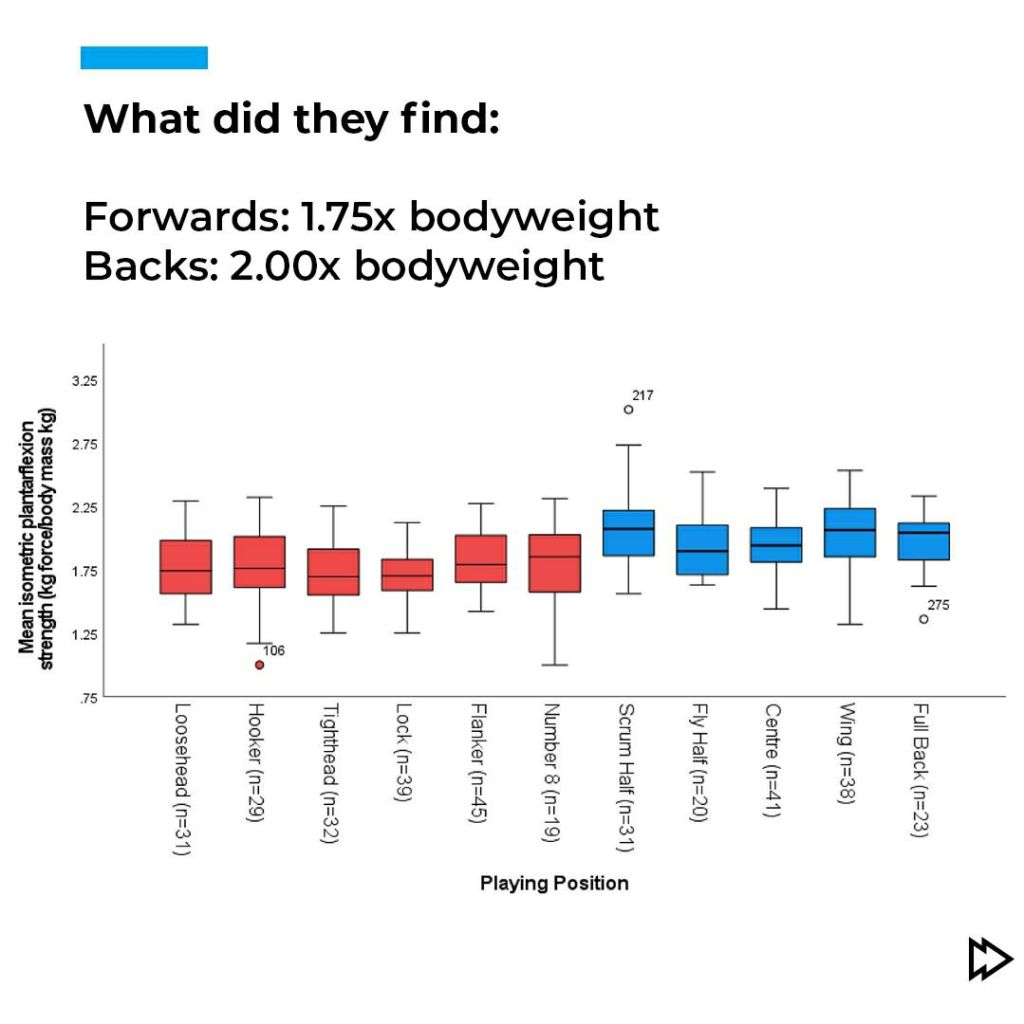
For the entire group (n = 355) the mean combined-limb isometric plantarflexion strength was 193.1 kg (SD 32) which corresponds to ≈1.86 × body-weight (SD 0.31).
When stratified by position:
Forwards averaged ~1.75 × body-weight (SD 0.26)
Backs averaged ~2.00 × body-weight (SD 0.28)
The difference between forwards and backs was statistically significant (p < 0.0001).
Age category (within the adult professional cohort) did not appear to significantly influence plantar-flexor strength.
Interpretation and Application
Positional differences
The finding that backs demonstrate higher relative isometric plantarflexion strength (≈2.00 ×BW) compared to forwards (≈1.75 ×BW) is noteworthy. Backs in rugby typically perform more high-speed running, rapid changes of direction, and acceleration/deceleration tasks, which place greater demands on the plantarflexor complex. In contrast, forwards engage more in contact, scrummaging and short-range, high-force tasks rather than repeated high-speed locomotion. The relative lower xBW in forwards may reflect differing neuromuscular demands, training emphasis, or muscle-morphology (e.g., more mass, potentially slower contractile characteristics).
Normative benchmarks
From a practical standpoint, strength and conditioning coaches or physiotherapists working with professional male rugby union players now have a benchmark: aiming for ~2.0 ×BW plantarflexion isometric strength for backs, and ~1.75 ×BW for forwards would align with the cohort studied. Players markedly below these values may represent a performance or injury-risk concern.
Age invariance
That age (within this adult‐professional sample) did not influence plantarflexor strength suggests that once a player has reached professional status, maintenance (or small decline) of plantarflexion strength may be stable—though longitudinal data would help confirm this. It may also indicate that training at this level buffers age-related decline, at least in the plantarflexor system.
Clinical & Performance Implications:
Injury prevention & rehabilitation
Given the high incidence of calf muscle strains, Achilles tendinopathy and other posterior-chain foot/ankle injuries in field sports, having normative strength values offers a useful criterion for return-to-play decisions. For example, in rehab after injury to the triceps surae/Achilles complex, the clinician may use the ~2.0 ×BW benchmark (or position-specific benchmark) as a strength goal. Players failing to reach these benchmarks may remain at elevated risk of reinjury.
Screening & monitoring
Isometric plantarflexion testing (as per the set-up in this study) can be used as part of routine screening to identify players who may be under‐performing in the plantarflexor system. Particularly for backs, if a player is well under 2.0 ×BW, there may be value in targeted training (e.g., heavy isometric/eccentric calf work, plyometrics, ankle‐plantarflexor strength programs). For forwards, the ~1.75 ×BW target can inform training progression.
Training implications
To bring players toward these normative values, strength coaches might emphasise:
Heavy seated or standing calf raises with long muscle-tendon loading (e.g., slow tempo, full dorsiflexion to plantarflexion)
Isometric holds in maximal dorsiflexion (mimicking the test posture)
Plyometric calf/ankle drills (hop variations, reactive calf work)
Regular monitoring with the same device/protocol to track progress
Moreover, the positional difference suggests training programmes might differ: backs may benefit from increased demand on plantarflexor strength and reactive capacity; forwards may prioritise other musculature but should still maintain relative plantarflexor strength.
Limitations & Considerations
The study is cross‐sectional: so while norms are produced, causal links (e.g., higher plantarflexor strength → improved performance or reduced injury) cannot be definitively established.
Sample is from English Premiership clubs: generalisability to other leagues, nations, or playing levels (amateur/semi-pro) may be limited.
The specific test set-up (seated, knee‐flexed, maximal dorsiflexion) should be replicated if one is to compare to the normative values; other protocols may produce different absolute values.
The data are normalised to bodyweight (×BW) but may not capture other important factors such as muscle architectural differences (e.g., fascicle length, tendon stiffness), neuromuscular activation, or multi‐joint functional tasks.
While age did not show an influence within the adult sample, the study may not have had sufficient spread (very older players) to detect age‐related decline; also longitudinal tracking is lacking.

Recommendations for Practitioners
1. Adopt the same testing protocol: Use the seated, knee-flexed, maximal dorsiflexion isometric plantarflexion test (Fysiometer or equivalent) if benchmarking players against these norms.
2. Position-specific targets:
For backs: aim ~2.0 ×BW or greater for combined‐limb isometric plantarflexion strength
For forwards: aim ~1.75 ×BW or greater
These values provide a realistic performance‐based target.
3. Use as part of injury‐risk screening: Players significantly below the normative value may warrant additional training focus or monitoring, particularly after calf/Achilles injury.
4. In rehabilitation: Use normative values for strength goals in return-to-play protocols for posterior‐chain/ankle/calf injuries.
5. Training load monitoring: Track changes in isometric plantarflexion strength over the season to identify fatigue or decrements (which may pre‐empt performance drop or injury).
6. Contextualise with other assessments: While the plantarflexor is important, other strength/power capacities, tendon health, plyometric ability, and contextual demands (running speed, change of direction, contact forces) must also be considered.
Conclusion
The 2023 study by Lee et al. provides valuable normative data for isometric plantarflexion strength in professional male rugby union players, with clear differences by positional group (backs vs forwards). These benchmarks (~1.86 ×BW overall; ~2.00-×BW for backs; ~1.75-×BW for forwards) offer strength and conditioning coaches, physiotherapists and sport scientists a concrete reference point for performance profiling, injury rehabilitation and monitoring. As with all normative data, these values should be used alongside broader context (player role, injury history, functional demands) but represent a significant step forward in the objective profiling of the plantarflexor system in elite rugby union.
Reference:
Lee, M., Lancaster, M., Tulloch, L., O’Leary, B., Power, E., Howes, D., Sourbuts, B., Berry, A., Maher, F., & O’Neill, S. (2023). Normative isometric plantarflexion strength values for professional level, male rugby union athletes. Physical Therapy in Sport, 61, 114-121. https://doi.org/10.1016/j.ptsp.2023.03.007
Article sources: https://twitter.com/sportsmapnet/status/1645651795962736641?s=09

 Hellotherapy